Don’t Be A Mug
The Mirabel Hoax and Why Tears Aren’t Evidence

This isn’t a Substack about rape. It’s one about not being a mug.
When I was about 13, something really strange happened in my church. An older teenager — around 18 or so — at the time, was kidnapped. Her mom was my mom’s friend, so this episode was quite distressing to the whole church. The girl had somehow gone on an errand and simply didn’t return.
The first day passed. The second passed. The woman had reported the case to the police station and had tried her best to find this girl. In fact, it was getting to a point where all she was left with was spiritual intervention.
On the third day, the girl, just like Jesus, arrived. And she had quite the story to tell. Apparently, she’d been kidnapped by either ritualists or kidnappers. It’s been so long now, so I cannot recall her story word for word. The point, though, is that she claimed to have escaped via the grace of God.
Her mom, who was just so happy to have her back, stopped the questions there. Satan had kidnapped her child, and Jesus had delivered her. The next Sunday, she made sure to testify to the goodness of God on the pulpit. Everyone in the church rejoiced and went home. Except, of course, one pastor.
This pastor doubled as the choir master, and since the girl in question was in the choir, he had quite the rapport with her. He didn’t think this story made any sense at all, so he decided to pay the girl a visit. He went to their house, told her mom to excuse them, and began his questioning.
By the end of the night, our victim had a different story to tell. She hadn’t fallen into the hands of kidnappers. Instead, she’d decided to go visit her boyfriend in Ogun state. She provided the number of the boy, and the pastor confirmed the story himself.
When my mom narrated this story to me, I couldn’t believe it. How can someone cook up such a crazy lie? Why? How crazy can you be to cook up such a lie at eighteen? How indeed.
When I saw the first Mirabel story, I quickly scrolled away. I was already exhausted by the bad news in the country, and I just wanted to sing along to my trenches TikTok sounds. I came on Twitter during a work break, and saw that the story was already viral.
And then I arrived on Twitter and found the same story being shared. I checked out the TikTok account and saw a posting history that suggested an upcoming creator. She’d tried making viral videos before, and they never quite panned out. I work in the creator economy, so I know the backend of these things.
What are the odds that something so attention-worthy happened to someone so attention-hungry, I wondered. Importantly, the details of the case itself were baffling, to say the least.
According to her, the rape happened in the morning when someone — a total stranger — barged into her home, tied her up, and raped her. She says she passed out and couldn’t resist the man because she was drunk. The rapist also tied her up and muffled her mouth so she couldn’t scream.
She says all her neighbors had gone to church (this is a vital plot point), so no one could hear her. This went on for at least twenty minutes. Then she says the rapist sent her a text on TikTok the next day, and the messages were quite something.
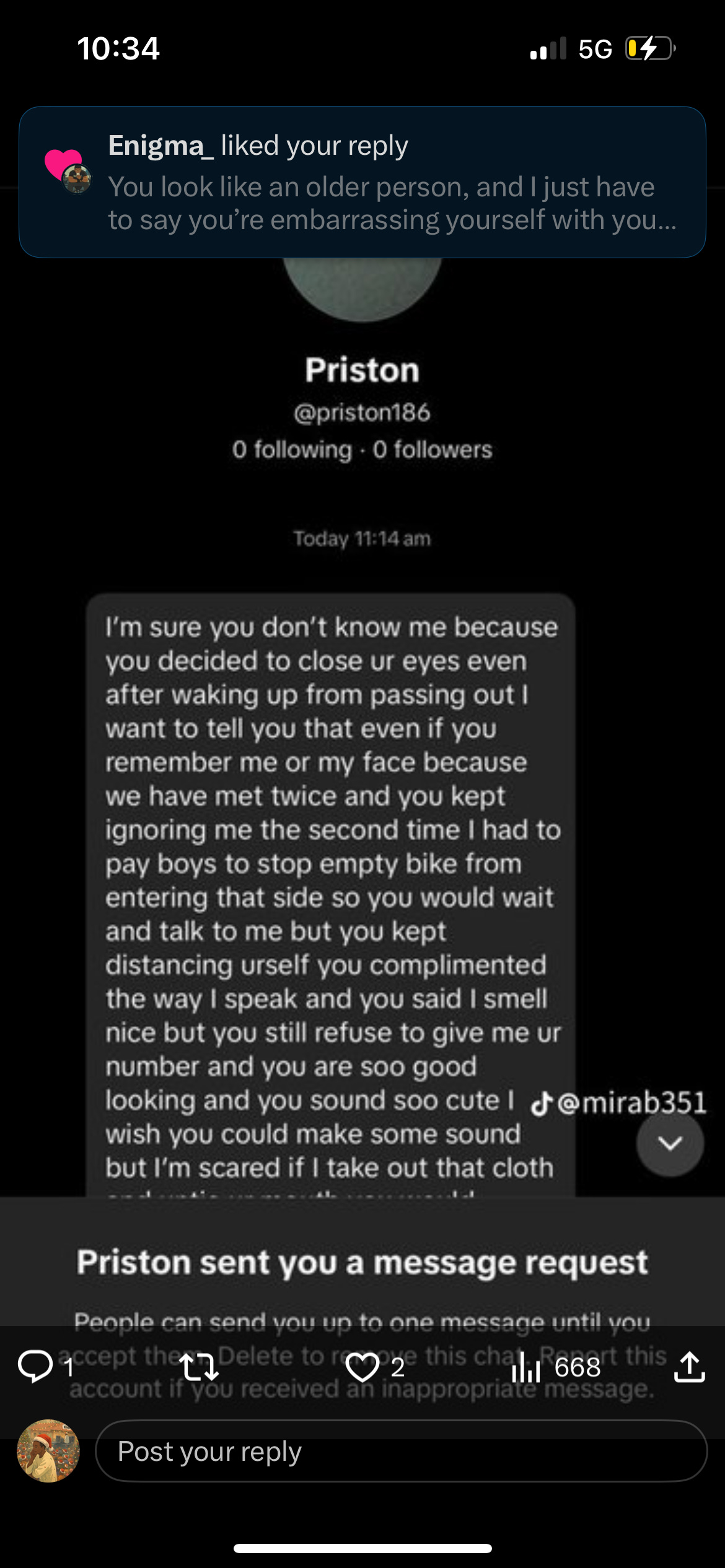
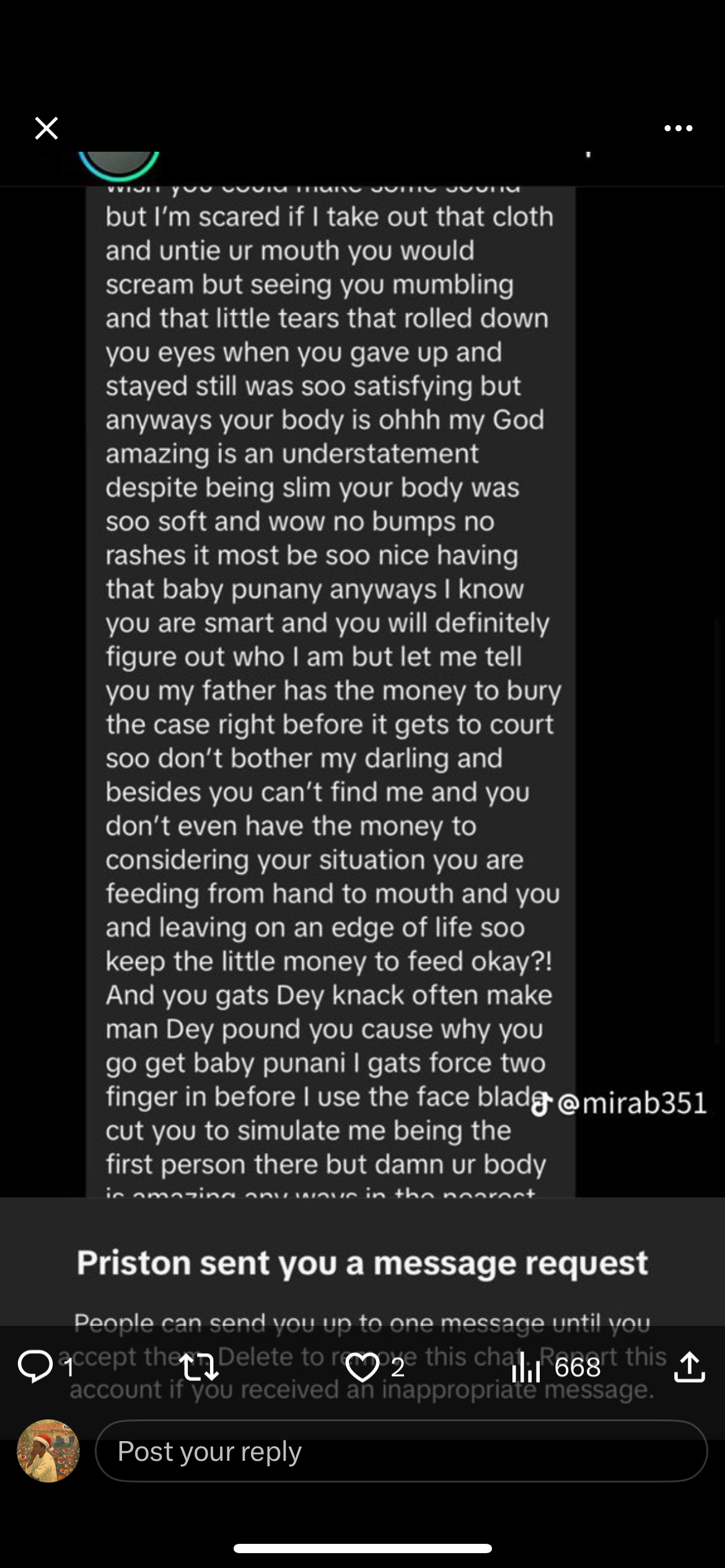
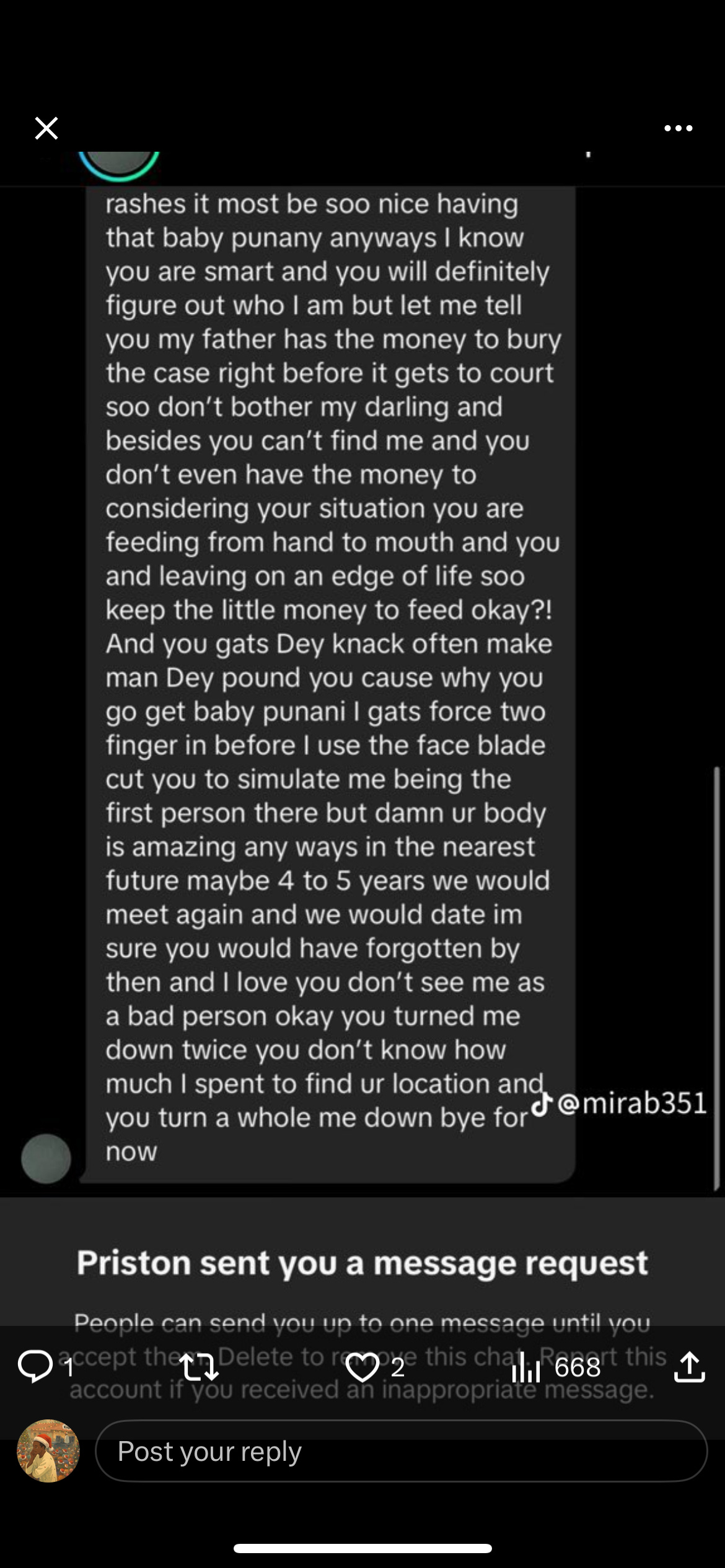
In the messages, the rapist (in horrible grammar — the fact that I’m still subjected to bad grammar in a world of free ChatGPT is insane) lets us know five vital facts. A) He says he isn’t a total stranger, and has seen her a couple of times. B) That he’d tried to speak to her, and had even paid bikemen to not enter her street so that she could talk to him. C) That she’d spoken to him and even complimented the way he spoke — and said he smelt nice — and still refused to give him her number. D) She was a virgin — so he had to use a blade to cut and “stimulate” her. E) She had a baby punani with no bumps.
Really? Seriously?
The rapist doesn’t explain how he found her TikTok handle, and merely adds that he has wealthy parents who would “bury” the case if she ever tried to find him. Isn’t it so convenient that this fellow decided to use Tik Tok, instead of WhatsApp, to communicate this view? And does it have something to do with the fact that WhatsApp numbers can be traced, and Tik Tok burners can’t be?
For his story to be true, we had to imagine the most psychotic human being ever. This fellow had to be extremely rich, extremely smart, and also extremely dumb. The fact that he caught her exactly when her neighbors were out and she was drunk is evidence of days of diligent monitoring. The fact that he could pay bikemen off (don’t you know how money hungry Nigerian bikemen are?) meant he was extremely rich. And the fact that he did all of that, and still went through the trouble of sending her identifying information meant he had to be extremely stupid. What sort of rapist would do that?
It made absolutely no sense to me. It would make more sense describing a man with two heads than describing a rapist who would be smart enough to track her, yet foolish enough to send her a five star review on her baby punani.
Since my day job used to involve reading thousands of words of the worst smut you have ever read online, the tone of the text disturbed me. A more critical reading gave the impression that the writer was more interested in painting the victim as a sexy one taken by a rich, cunning daredevil (who just really wants to marry her in five years) named Priston. Oh, dark, tall and handsome Priston, don’t rape my baby punani with no bumps. You could almost remember reading a Harlequin romance novel — or something equally horny on Wattpad — with this plot.
Furthermore the letter wasn’t one of malice or triumph… it was one of seduction. It was like the description of her body was meant to be arousing to the reader. It was almost like the words jumped out of someone’s sick, twisted, fantasy. The fact that the rapist spent more time talking about how good her body felt, and how much of a great lay she was, rather than why he did it, or even mocking her, just didn’t make any sense to me.
Importantly, this whole confession was happening barely a week after another woman’s rape story had gone viral. It seemed likely that the entire episode was an invention by the lady to copy the same template and have the same success.
Seriously, think about it; why would a rapist send his victim a glowing review? Why would he mention that she had “no bumps?” What sort of demon wouldn’t simply be glad for the opportunity of the rape? It is like a thief sending you a letter appreciating your devices after robbing your home. Can you truly imagine something like that happening? If a stranger on the road told you that story, would you believe it?
Once I read the text, I knew there was a high chance that this was all a lie. Later that day, I learned that the girl had taken Sniper. And two minutes later, I learned that she’d recovered and had been discharged from the hospital. I’ve read the description of the violent spasms that people suffer from drinking Sniper, and I assure you it’s not something anyone could drink and recover from in a day. That settled the matter for me, and I immediately told my friends that she was clearly lying about the matter. Many refused to believe. They were all wrong.
But it wasn’t all their fault. The video the girl made was extremely touching. She even cried as she narrated this insane occurrence that never happened. She seemed so honest, so innocent, so right that it’s almost impossible to disbelieve her. As such, people were already emotionally invested in her story being correct — even before they read the texts.
The fact that this was an unambiguous crime — that is, there could be no question that this was rape — also made the case a perfect crystallization of every feminist argument. You see, even women who sit in their rooms and mind their business are still not safe from the outstretched hand of the violent nature of Nigerian men. It was the perfect case.
But the problem with perfect cases is that they need to remain perfect. If this one great perfect case was questioned, or proven to be false, it could destroy the whole argument. This ironically led to a situation where feminists were hoping their one perfect case was true — and that this lady had been gruesomely raped — over the alternative. You know your case is different when thousands of women are wishing you actually got raped for over twenty minutes by a stranger so that they can win their little arguments online.
The problem here, of course, is that this one case was completely irrelevant. Right now, as you read this essay, there’s a woman who was previously minding her business in her home who is now getting raped by a stranger. In fact, there may be hundreds of thousands of such women suffering the same thing right this minute. Before you finish reading this paragraph, it would have happened to at least a hundred more women.
In essence, there was absolutely no reason why this one case had to be true. There is no shortage of victims to champion. Nothing was riding on it. There is nothing tied to the truth of this case. It’s irrelevant, and totally unimportant. And yet, people went mad over their friends believing it or not. It was a horrible hill to die on, and yet many wanted to die on it. I must admit that I somewhat enjoyed the sputtered squirming of many influencers as they tried to justify their unfounded panic with every other rape victim they could think of. Oh yeah, Mirabel was lying, we agree, what about Ochanya? What about it?
When cases like this enter the national consciousness, it often induces a moral panic. There is usually an urge from people to “speak up” and “say something” and “protect”. I am uncertain of the efficacy of these campaigns, as I doubt any self respecting rapist would repent upon seeing a strongly worded social media campaign, but people are free to do what they want.
This panic also came upon Mirabel’s case, as many friendships dissolved at the question of believing her testimony. Her case was the perfect one, and that made it the perfect purity test. If you didn’t believe her story, you were stupid, wrong and hated women. If you did, the angel of death would pass over your door.
Popular Busy Body and professional rage baiter VDM eventually got a hold of Mirabel and got her to confess to composing the messages herself. This turn of events was ironic, as dear Mirabel had asked to speak to VDM herself. Many women volunteered to help, but she really wanted to go viral so she only picked VDM’s call. Again, the fact that many people didn’t realize she was making the story up at this point baffles me. Are they also this gullible in their personal lives?
In any case, that error turned out to be fatal for the lie as VDM quickly got her to confess to making the whole thing up. It was precisely as I’d suspected. Nobody had raped her, she’d sent those messages herself, and this was merely her latest attempt at going viral. Unfortunately, she had overcooked and burnt the kitchen. Who amongst us can say they haven’t invented an elaborate traumatic episode in order to cash in on money and attention online?
Before VDM even released the call where she confessed to lying, her neighbors — the ones she said went to church the day she was assaulted — had gone on Tik Tok live to debunk everything. They even said she’d just recently lied to them about her dead mom and they had contributed money for her. She’d not told them about the assault, and they only learnt of it for the first time online. So, at this point, there was absolutely no question that she was lying.
Of course, this turned out to be extremely uncomfortable news for people who’d burnt bridges over this totally needless purity test. They didn’t take it well at all.
But whose fault is that? The really embarrassing thing here, at least for me, isn’t that this perfect story turned out to be a lie. It’s that this “perfect story” was believed by people anyway. I suppose the video itself and her crying performance was somewhat moving, but any serious person would have a wary outlook towards the case by just reading the texts the rapist sent.
However, not only were people wholly taken in by this transparent scam, some even bragged about it. Here’s a common type of comment many people made after finding out they were taken for fools;
I will always be on the side of the victim. If a victim turns out to be dishonest, I will be on the side of the next victim. Na una sabi the one wey una dey do.
If one had a mental model that said there was no chance a woman crying online is lying, and it turns out that she’s lying, wouldn’t the clever thing to do be to recalibrate that mental model? To show that there’s some chance a woman crying online is lying? Wouldn’t it be dumb to ignore that data point — that wasn’t predicted by your mental model — and move on like all is right in the world?
It’s shocking one has to say it, but there’s no pride in being taken for a fool. In fact, being fooled should make one even more angry at the perpetrator of the mischief than anyone else.
Yes, you shouldn’t be ashamed of believing women, however you should be ashamed of being gullible. The big problem isn’t that she lied (at least to me) — it is that it was a really bad lie that an honest and sensible appraisal of the facts would have easily revealed. Even if you will be deceived, at least let it be by a good liar. Being deceived by a stupid lie is the equivalent of Lingard Molly-rocking at the Emirates. You’re really proud that someone sold a dumb lie and you believed? Are you really sure you want to make it in Nigeria?
You could argue that there is no perfect story, and every assault story has holes as no one has perfect recall. But this story didn’t just have holes, it had tears in the space-time continuum. It had a 99.999% chance of being false. There was almost no way it could be true.
Now, the people who believed her aren’t totally stupid. I’m sure many ordinarily found the story incredulous. However, they likely went along because it’s been drummed into their psyche that they need to “believe women”.
Others attempt to provide intellectual cover for their gullibility by citing ‘stats’ that show false accusations are rare. However, using a general trend to validate a specific case is a textbook ecological fallacy: the logical error of assuming that group-level probabilities dictate individual realities. Even if 99% of accusations were true, that macro-statistic has zero bearing on the internal consistency of this specific story. A statistic is a tool for public policy, not a hall pass for a bad liar. To ignore glaring contradictions because ‘the numbers’ are on your side is to treat a human being as a mere data point rather than a narrator—which is ironically the very thing activists claim to loathe.
Even the most prestigious intellectual organization to argue for a de facto belief of female victims stance does so with extensive caveat. The American Constitution Society, the organization in question, only argues for the belief of female victims with credible accusations. This accusation, as I’ve shown, was the opposite of credible. In fact, it was a textbook example of an unreliable narrator making up an incredible story as they went. And yet people believed. Even right now, as you read this, there are many who believe her confession was false, and VDM actually coerced her into confessing. I would be so embarrassed if I believed that. Yet many do.
This brings us to an interesting problem. What do we then do when someone accuses another person of sexual assault? And the answer, to me at least, seems to be literally the same thing you do when someone accuses another person of any other crime. You ask for evidence, and failing that, you look at the internal consistency of the story and make a judgement call. The good thing to remember is that your judgement call is just that — a judgement call. It doesn’t guarantee that the story is truth or false, just like any other case. And, importantly, someone having a separate judgment call from yours isn’t automatic evidence of evil.
Imagine if everyone had completely believed her, despite the glaring holes in her story. Imagine the lie had held up, and the police was now on a search for a psychotic animal that doesn’t exist. How confident are you that some poor innocent fellow wouldn’t be ID’d by this crazy person in further pursuance of her lie? We need to be wise in this country.
One last thing. The strangest comment I’ve heard from people discussing this case is that it makes it difficult for others to take future rape victims seriously. But that makes no sense. We all know rapes happen, and we all know who the victims often are. Why would one case change anyone’s mind about a statistical trend? That’s an even dumber fallacy to commit! If the story is consistent, and the evidence is plausible, why should one case of a really bad liar push anyone to disbelief of all future cases? I’ve found such comments to be evidence of extremely low quality thinking.
The lesson here isn’t that women lie. It isn’t that rape doesn’t happen. It isn’t even that you shouldn’t be compassionate. The lesson is much simpler: do not outsource your brain.
If a story doesn’t make sense, it doesn’t suddenly become coherent because it aligns with your politics. Tears are not evidence. Virality is not verification. And moral pressure is not a substitute for thinking.
You can support victims without surrendering your judgment. You can care deeply and still ask questions. In fact, in a country like ours — where deception is currency — refusing to think critically is not kindness. It is liability. And we all know you can’t go far in Nigeria if you’re an easy person to trick.
Believe women? Fine. But believe evidence more.
A wise man once said, “In God we trust, all other must bring data."
I am not a fan of tiktok but my younger sister kept feeding me the story. It wasn't adding up. How many victims of rape find it easy to jump in front of the camera without evidence? You mean she didn't show a hospital report? You mean she didn't report to the police station and give the police his name?
Until rape gets a capital punishment, many rapist will still get away with it.
Our brain naturally attaches to negative stories more than positive ones, explains why a lot of people believed her at first,
I didn't even have TikTok, when i saw people talking about it, so I installed and checked yesterday, and it abit obvious that the story doesn't quite add up.
And the fact of these whole scenario, is that ladies quickly believed when she claimed she was raped, and guys quickly believed when it was discovered as a false accusation, we are all just naturally baised to our gender, and most aren't conscious of it.
In a world full of people with different stories everyday, I would just say what can be asserted without evidence can be disproved without evidence, everyone has the right to choose what they decide to believe.