What Did You Seriously Expect?
Nigerian political parties attempt to conduct a "direct primary" election.

If someone wrote satire about a fictional African nation and filled it with the real life happenings in the Nigeria political space, many would reject it for being too ridiculous to be true. Your editor would tell you that even fiction needs to be realistic, and you should stop imagining scenarios that could never happen. But they indeed do happen, and nothing has grounded this than the last two or three months in Nigeria’s political space.
After passing the strange Frankenstein of an electoral act that essentially outlawed indirect primaries, our political parties — ADC, APC and NDC— were legally bound to either nominate candidates through consensus (which is another name for “baba so pe1”) or direct primaries (where all party members are allowed to vote), which we are learning is “Baba So Pe” with democratic characteristics. If you know anything about logistics and the size of Nigeria, you would know direct primaries here are essentially impossible.
Further complicating this was the fact that one of the parties, the NDC, is younger than six months. There are over a thousand electoral positions open for voting in 2027, and a national party, that NDC claims to be, has to — or at least has to try to — get nominations for all of those positions. If you have ever worked in logistics, you would know how difficult doing this would be for a new party, especially as party leaders and workers do not draw a salary and are often risking their lives when carrying out their function. Leading a group of just fifty people and ensuring they complete a complex task with many moving parts is complex enough when they are getting paid to do it. It is nearly impossible when they are not. And that is in even ideal conditions.
In any case, none of the parties, who were already boasting of “millions of members” (yes, including the NDC) had the institutional knowledge nor logistical capability to carry out a “direct primary election”. This should have been obvious to the lawmakers who passed the law, but like I wrote somewhere else, they clearly didn’t read it, or if they did they didn’t understand what they read.
APC? Please Change!
The first sign that there was fire on the mountain was when aspirants in the APC, like the king in Oyo state (yes, the governorship aspirant for the APC is literally a crown-level royal), started a strange game of telephone by claiming that Mr President had already picked someone (him) as the consensus candidate. My people say whom amongst us would be given a hoe to clear a farm and wouldn’t clear it towards his own side?
This position was strange to me, as Tinubu didn’t even behave like Oyo state existed. The other senior leaders in the party quickly fell in line, except for His Excellency, the minister of darkness (I’m being harsh, but have you seen that man’s stomach? He can take it), Adebayo Adelabu. To show that he was well and truly still in the game, he resigned as minister and promptly took on a job as a traffic official on his return to his native Ibadan. Maybe if Tinubu makes him minister of traffic, he would ensure we have none!
In any case, King Sarafa couldn’t believe this, and ultimately hosted what must have been 47 parties (at least) to announce himself as the consensus candidate. It, of course, was merely a show of power with other party leaders to try and intimidate Adelabu into agreeing that the president said what he obviously didn’t say. This stalemate eventually bled into violence at the APC secretariat. In the end, the primaries were conducted, and according to every available evidence Adelabu beat Sarafa blue black.
However, party leaders from Abuja prevailed on state chairmen to not announce the winner. To be clear, the state chairmen were not about to declare Adelabu winner — they had already written in over five hundred thousand votes for Adelabu and were prepared to announce it and damn the consequences. In fact, people had already started congratulating king Sarafa on his win.
Since that plan did not work, for reasons best known to them, Sarafa and Adelabu went back to Abuja to do the “real job” of negotiating their tickets, and it seems Sarafa eventually won, as he appeared in Bourdillon, the president’s home, in a meeting with customized caps. After the meeting, Sarafa spoke to the press and told them that he was the governorship candidate, thereby putting the issue to rest.
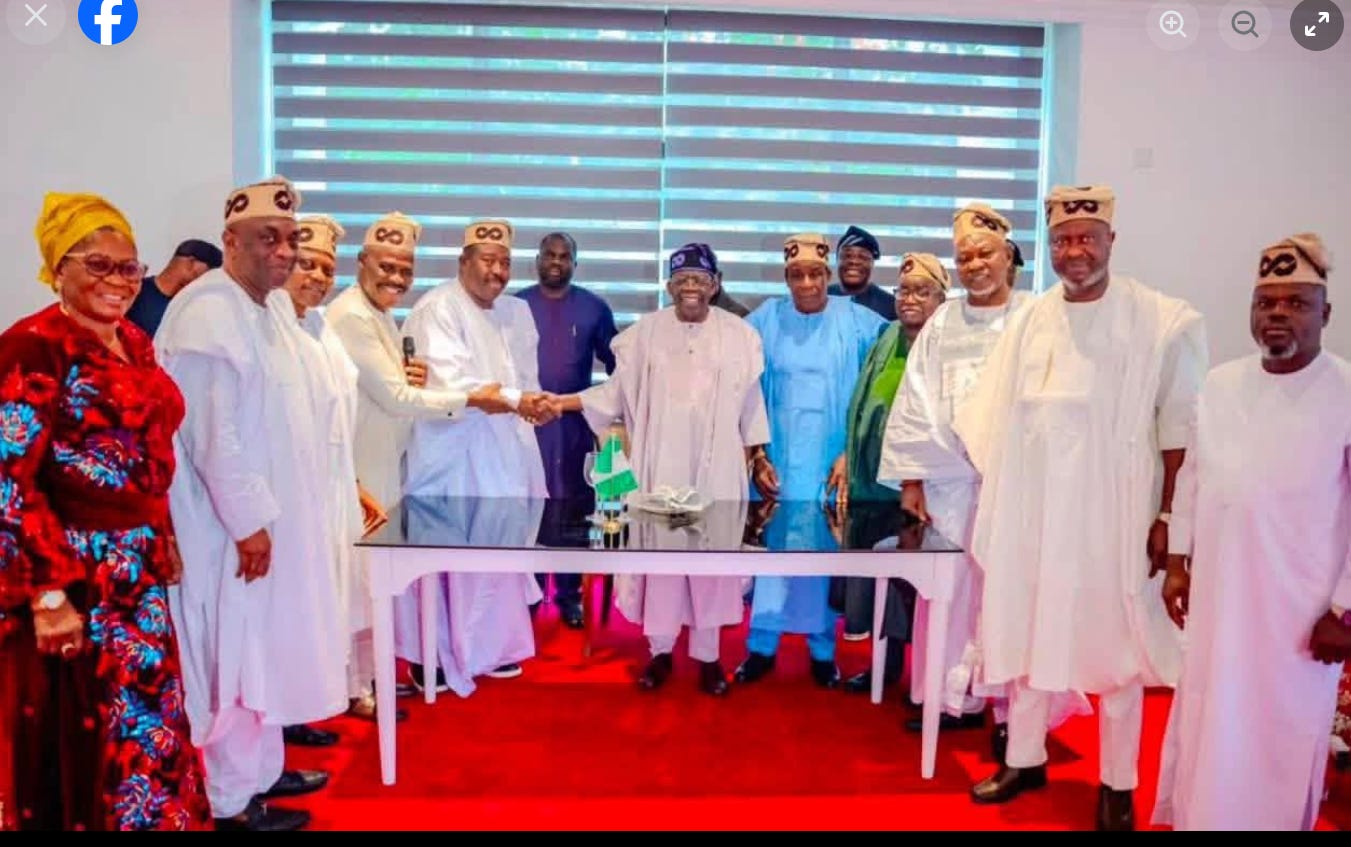
Or did he? We literally do not know, as Adelabu could also appear wearing the customized caps tomorrow claiming the same thing. Through all of this, the party is yet to officially announce results — in fact, some are saying they have already agreed never to release the results! Yes, this is Nigeria, and this is how we play our politics.
Very similar scenes are also playing out in Lagos, where aggrieved leaders and their lackeys won the primaries, but state chairmen and state stakeholders, who are bound by nothing but the love of God and the sweet fellowship of bank alerts, have been in the sweet business of exchanging names. In order to legalize their “hacktivities”, the state exco of Lagos State put out an ad in a newspaper listing the “winners” of the Lagos primaries. The next day, the national publicity secretary came on TV to tell the world that the only authentic names are the ones released in Abuja. Well, where are the names? Ah, we are still collating. One wonders how long it takes to collate results that state leaders were already ready to announce. But people who have been Nigerians for long enough know that this delay is merely a tactic for the national structure to subvert or reinstate the wishes of the people wherever it benefits them.
Despite this delay in announcing state results, the party announced the winner of the presidential primaries, the one where our Lord and Father Bola Ahmed Tinubu contested against a certain Mr Osifo (in Yoruba Osifo can be interpreted as rubbish flies, which is just as well) who apparently has 100 million naira to waste on buying an APC presidential form. There are many theories about where Mr Osifo arrived from, and many are saying he was merely a plant — or a foil — for Father Lord to defeat. Who knows? Perhaps he may be hoping for a Yahya Bello-esque miracle, or just loves seeing his name on TV. However, considering that it isn’t Mr Osifo’s first time doing this, I suppose he gets a kick from adding “former Presidential aspirant” to his CV.
The real drama of this primaries came when the results were announced. The president got nearly eleven million votes while Osifo got nearly twenty thousand. We all expected Tinubu to win, as the primaries were for show anyway, but eleven million votes? The state by state breakdown was even more ridiculous. He got almost six hundred thousand votes in Imo, a state where he only got 66,000 in 2023 general elections. Importantly, even the winner in Imo in 2023, Peter Obi, got only around 360,000 votes. But somehow, the party told the world, not in campaign rhetoric, but in facts and figures, that it counted nearly 600,000 humans in Imo state who wanted a second term for Tinubu! Really? In Imo?
Even the total number of votes beggars some belief. In the last election, he got around 8 million votes. In this one, he found more than three million votes more. The most astonishing part is that the numbers literally didn’t matter. He could have won by one million or two million votes, and it would be irrelevant. He could have skipped the process entirely and gotten adopted by consensus. He was always going to be on the ballot. And yet, in an election whose result didn’t even matter, the party was able to debase and tell itself such blatant lies. It almost feels like you live in a communist dystopia and the party is Big Brother. How can you crap on my head and insist that rain is falling?
Some fellow reading this may think, ah, look at that. The ruling party is so corrupt! That is why we have to vote them out! And I agree. But first, let us consider the primaries of the parties we expect to defeat them. You would imagine it cannot get worse than this, and I also imagined that, but that was because I forgot that I lived in Nigeria. I won’t make such a mistake ever again.
The African Democratic Congress
The ADC, which could probably more accurately be called the Atiku Democratic Congress, also heaved and pushed itself into direct primaries. The party had three aspirants; Landlord, Rotimi Amaechi and some fellow named Hayatu-Deen. Hayatu-Deen, just like Osifo, seriously planned on winning the elections. He even held a small gathering of “like minds” in Abuja to “share” his vision. Hayatu-Deen isn’t even a christian, yet he has the faith of a mustard seed. Sadly, this isn’t Bethlehem, and here your faith won’t make you whole. In fact, it will just make you suffer since you are very stubborn.
In any case, the ADC primaries came and went, and as it was obvious from the beginning, Atiku blew both Hayatu-Deen and Rotimi out of the water. Most of the states saw up to 90% voter turnout. Which, as you know, probably means people just wrote whatever figures they liked, just like APC did with Tinubu. But rather than endure the disgrace, both Hayatu-Deen (I told you he has a lot of faith) and Rotimi came on Twitter to claim the primaries were fraudulent. How? Walahi, brother, just believe me, I go lie for you?
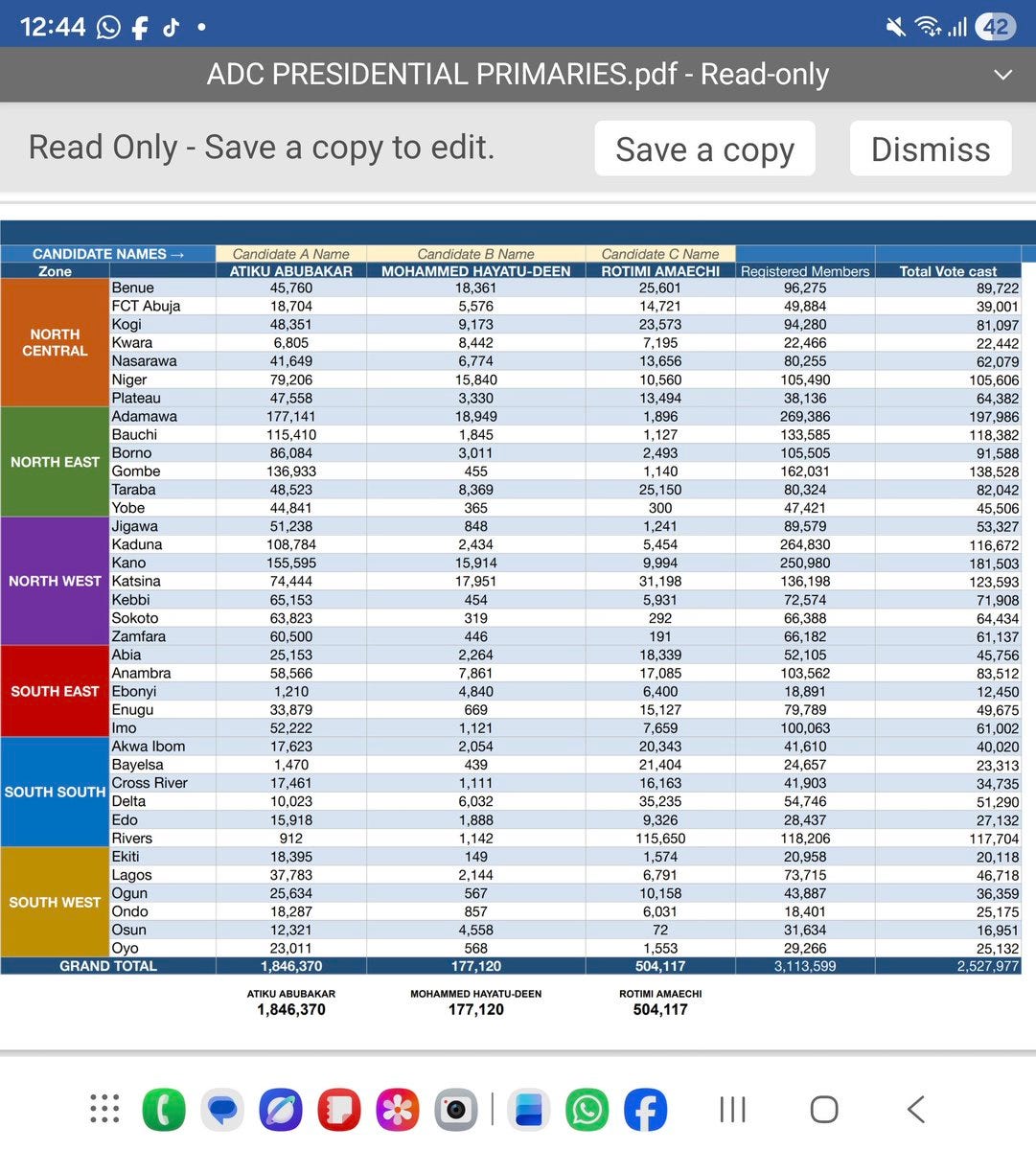
Rotimi even said that there was under-voting, as 80% of his supporters were not allowed to vote. 80%! Can you believe that? Seriously, check out the breakdown of the results in the image below. Can you believe it? Rotimi Amaechi saw these results and his grouse was that there was under-voting? Really?
What’s more, the results from Amaechi’s state were just as ridiculous. Is he saying those are real numbers and not an effect of rigging? Really? Do Nigerians believe any of this crap, you may wonder. Well, the answer is that they do. Many do, in fact. Many reading this would sputter and spit while they try to tell me these numbers are real, actually. It is a sad situation, but that is what politics is like in Nigeria. It is almost like some sick joke. Is this some sick cosmic joke, God?
What about NDC, the new bride of the Lagos “educated” middle-class? Surely there is better behavior on offer from Peter Obi’s anointed non-structure of criminality? Right? Well, let us find out.
The Nigerian Democratic Congress
The NDC, or Na Dickson’s Party, is essentially a startup of a political party. The only real difference here is that Dickson is ridiculously wealthy, so instead of starting off in a garage, the party is starting off in his sitting room.
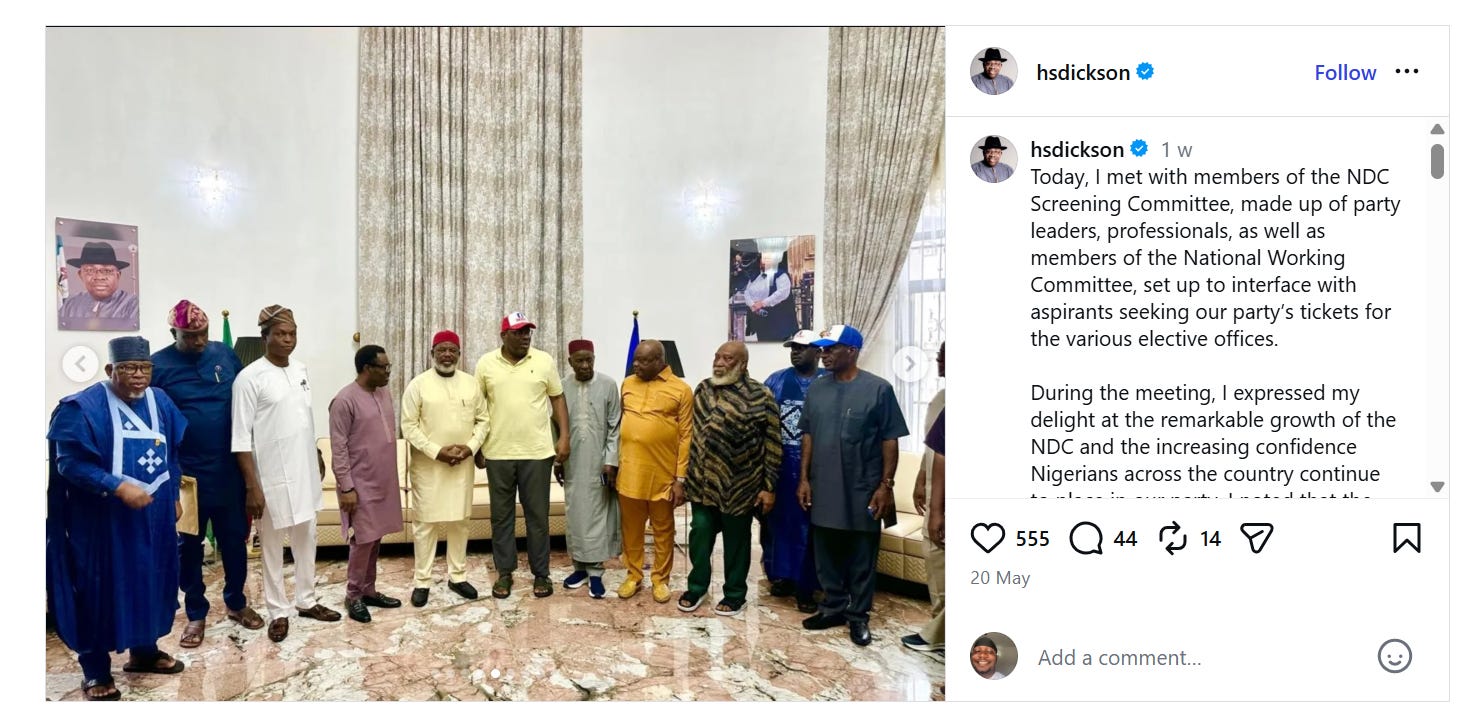
The NDC is really only held together by three personalities — Dickson, Obi and Kwankwaso. All three have their own spheres of influence, and they all have teeming followers who plan to be down ballot candidates. The big problem? The party can only present candidates gotten from direct primaries or a consensus.
Kwankwaso made no pretense of his choices, and promptly picked the down ballot candidates he was comfortable working with in his region and sphere of influence. For other positions where he either didn’t have a strong choice, or there were no strong candidates, he permitted primaries to happen. For positions such as governorship of Kano and Senator of his senatorial zone, he got the gladiators to agree to a consensus.
Because of the short window and the influx of new supporters barely three months to the deadline of submitting primary candidates by INEC, it was always going to be a tall order for the NDC to organize direct primaries that fielded strong contenders. Direct primaries across over a thousand positions in a country like Nigeria would cost —at the very least — hundreds of millions in logistics. The party would have to vet electoral officers (APC, for instance, conducted “elections” in over eight thousand wards), pay them, provide transport across localities, pay for stationery and perhaps even hotel stays for state collation officers. Even if just 6,000 people are hired (can you already imagine how big of a logistical headache this business is), and they are paid an average of 30,000 each in total costs, that is already 180 million.
So the cost and impracticality — as there is also the matter of the party not having officers in all the states — made the idea of nationwide primaries an impossible dream. However, the NDC was also wary of announcing candidates through a consensus (or, as I hear, someone in particular was wary of it) as their leading presidential candidate had once referred to such “consensus” as a “structure of criminality”. There was no way the party’s reputation would survive a consensus arrangement, and that became quickly obvious when Aisha Yesufu began campaigning, despite being told that the offer wasn’t on the table, for the party’s Abuja senatorial ticket.
Aisha, a loud and “action-packed” advocate of the masses with a million followers on Twitter made it her job to actually campaign amongst “party faithfuls” (remember, this party is actually barely six months old!) for their support during the direct primaries. She even found a way to the TV stations to market herself. Unfortunately for Aisha, she moved to the party late, and someone else had been promised the ticket 3,000 years ago. She eventually came to this realization when she saw that the slated “primaries”, at least in her case, were nothing but cardio. To commemorate her loss and inform her teeming online fans, she posted a video at 3AM (as you do) on the eve of the primaries. In the video, we can clearly hear someone who sounds like Dickson (look, I just started this Substack and I am rather poor, so please use your head when reading) telling people not to even talk about the senatorial ticket. What’s more, he accused the people he was addressing of being paid protestors from Aisha who came to “scatter” the process. Are you really a Nigerian politician if someone isn’t secretly sponsoring something against you?
In any case, Aisha Yesufu, rather than face the embarrassment of mobilizing people for a primaries that had no location, gave up on the process. Later in the day, she released a tweet to tell us all that she didn’t quit the race, she just couldn’t continue because the primaries was a “Process That Wasn’t”. She claimed it was merely a “predetermined outcome dressed in procedural formalities”. Chai, so sorry.
Unfortunately — or maybe fortunately — many others weren’t as astute as Aisha and indeed went on with the primaries across different parts of the country. Many people posted videos and pictures claiming this or that person won. However, the party itself, from reliable sources, warned aspirants not to announce the results or parade themselves as winners after the primaries.
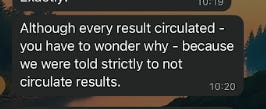
Now, why would the party want that? Why would a party of people who demanded “electronic instant transmission” in the electoral act suddenly be told not to announce winners of primaries? What is happening here?
You see, there is a pretty obvious game being played. At the beginning of the whole process, the national chairman told aspirants that he would only sell them primary forms after they win. His rationale for this was that he didn’t want to cheat them out of their money. Of course, that did not mean they wouldn’t buy the “expression of interest” forms. At least they would express their interests before participating in the primaries, right?
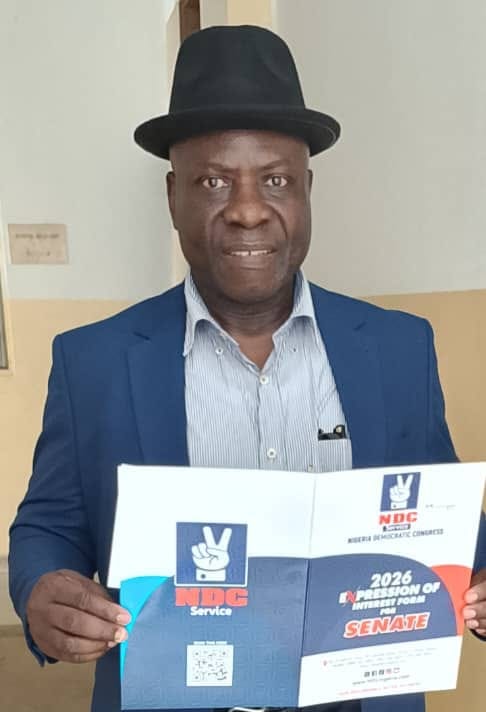
So the process is: you first buy the expression of interest form, contest in the primaries, and come and pay for the primaries form after winning. This, again, was to stop people from “wasting money” and not to “cheat” them. It is a rather queer arrangement, but there is some method to this madness.
One has to wonder when the desire not to cheat anyone has stopped a Nigerian politician from doing anything. But it all makes sense when you realize that the only legal standing one has — or could have — to challenge a faulty primary process is being actually cleared to contest the primaries. If the party never cleared you, and you never actually bought the form, can you really say that you were a candidate? Definitely not! You merely bought the form to express your interest, and your interest was expressed. What else do you want?
The legal magic gets even worse from here. Since only the NWC committee in Abuja has the right to declare winners, the party could merely release whatever names it wants as winners, and the losers would have no choice but to accept it. They did primaries, and your name wasn’t announced, why are you crying? If you produce some document, or tally, saying that you won, the party could just say it was unrecognized and you forged it. After all, state excos were not given the authority to announce results or provide copies of vote tallies to anyone. There is simply no documentary evidence you can use to prove your “win”.
It is really clever politicking, even if totally unethical, but this is Nigeria. And Na Dickson Party. Like I am now in the habit of saying; who will the wise person take advantage of, if not the idiot? What did you seriously expect?
Yorubas say that the horse in front is the one the rest follow. Lagos boys say follow who know road. The wise ones who know what game is being played are already in Abuja trying to see if they can pay to play, while the unwise ones remain in Lagos, hoping on Peter Obi to secure their legitimate tickets for them.
Chai, so sorry (in advance).
The NDC has now released a statement confirming my earlier scoop that the actual winners of the election will only be announced after a “NEC meeting” ordered by the party Chairman, Seriake Dickson. If you were born yesterday, you wouldn’t know what is going on. But I wasn’t born in Nigeria yesterday, so it is just as well.
I will end this section with a now deleted tweet from elder statesman and Very Serious Nigerian, Dr Amadi.
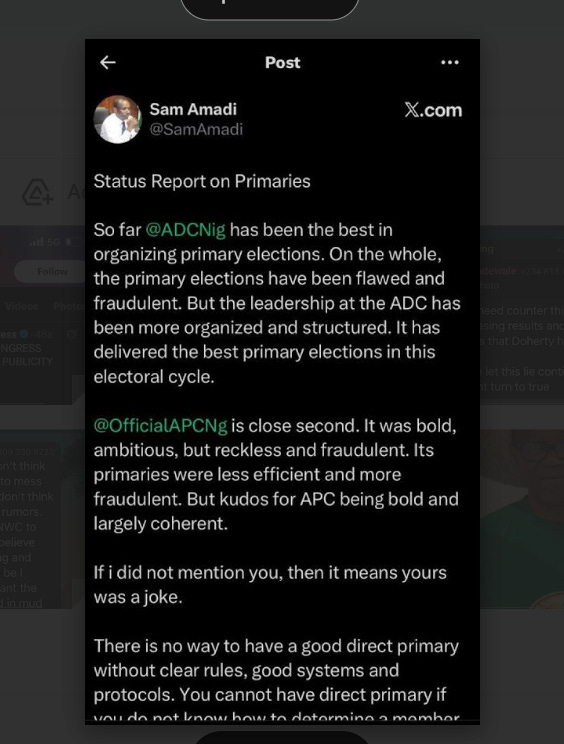
It is good that Dr Amadi deleted the tweet, primarily because it isn’t yet time to cry. There is still more than enough time for that. He should keep his tears for now.
Direct Primaries Are Probably Good
The Nigerian political class has covered itself in filth over the past few weeks with these charades called “primaries”. If these parties cannot even be honest to themselves and count their own votes faithfully, even when nothing is at stake, what does that say about their protestations when INEC also announces crazy results? Why do they complain so seriously about rigged elections? If the parties themselves are allergic to a free and fair internal election, why do they expect it from an outsider?
The truth many Nigerians don’t want to hear is that Nigerian elections are not free and fair primarily because organizing an election across a country as vast as Nigeria is extremely difficult, even if you have a heart of gold. It is a herculean task, and INEC, as a state agency, is the least capable of carrying it out. If you have ever worked in the logistics business, you would know how difficult it is to manage just ten riders. Imagine managing over seven hundred thousand ad-hoc staff in a country as large as Nigeria. Imagine coming up with strategies to deliver ballot boxes to all the nooks and crannies of this country. Imagine the logistical headache of merely hiring the staff required!
After the last elections, I did some mental math on the odds of INEC hiring enough staff that are competent and honest enough to prosecute the elections faithfully. They would need to hire over seven hundred thousand ad-hoc staff for pennies. Do you think there are up to seven hundred thousand Nigerians that are competent and honest enough to risk their lives to work for pennies with INEC? If so, you need to update the assumptions you have about this country. Like I said, it is a difficult problem from both the human capital point of view, and the logistical efficiency point of view.
Therefore, asking INEC for free and fair elections in Nigeria is about as reasonable as asking NIPOST to be on time with your delivery. You can ask for it, but you need to know you are never going to get it. It will never happen. It isn’t because NIPOST hates you specifically. The system just isn’t set up in a way that delivers the outcomes you want.
Direct primaries, however, are a different ball game. Political parties can be really flexible animals, and they now have some incentive to at least project some veneer of legitimacy with their primaries. Rigged primary elections can lead to a wave of defections, or even serious anti-party activities. Therefore, the incentives of the party and of INEC are radically different. And since parties can be as flexible as they want, they can really grapple with the logistical and human capital problem in novel ways that may even teach INEC what to do. The Lord God of the NDC, for instance, has promised that the “next primaries” won’t be like this. He plans to make it electronic! And why not? If that works well in the NDC, who is to say the party cannot transfer that experience to INEC if it someday wins the presidency?
Aside from that, direct primaries allow elected officials to come face to face with the actual party members they serve and allow them to choose their leaders. Whatever the outcome with INEC at the general election is, we would know that at least a section of the country — and not just old men in some cold room (or even a shrine — look Nigerian politicians are insane people) with infrastructural deficits in the bellies — wanted the candidate. Despite the ugly manner in which they have now been conducted, I believe the incentive structure guarantees that they will be better conducted in the future.
However, we need to remember that this is Nigeria. I don’t expect the requirement for direct primaries to survive the next four years. The people who have gotten power through it will likely understand just how badly it will impede their staying in power, and how badly they suffered in pretending to organize a free and fair direct primaries, so I expect the law to be amended before 2031. This is what you get in Nigeria. What did you seriously expect?
Our father said so, or the Godfather has decided.
I can’t say I’m surprised by how they’ve conducted themselves. It was very predictable.
Direct Primaries my foot. Nigerian parties are just coalition of gangsters. Worse still is an electoral act designed to stop one person from contesting.