Nobel? No, Biko
Why do Africans not have a Nobel Prize in STEM?

Here’s a troubling statistic for you to consider; Nigeria, a nation of 200 million people, has only one Nobel Prize winner. A winner who won the prize around forty years ago.
It gets even worse. If we only considered the Nobel Prizes in the hard sciences, Nigeria has none. West Africa has none. That is, on its own, a community of almost five hundred million people. Central Africa doesn’t have one, and neither do East Africa. There are many brain-dead arguments Africans have for this.
Consider the first one, which is the pernicious idea that Nobel Prizes require unbelievable investment in technology and funding. And since these parts of Africa are as poor as poor can be, they are too broke to fund research. This argument sounds good and maybe even intuitive. But it is still stupid, as I will now show.
The first obvious reason is that capital allocation is, in itself, a skill. Dangote says he built his company through a $500,000 loan from his uncles. To many, that fact completely explains Dangote’s wealth, but how can it? If his uncle knew a surefire way to build a billion dollar empire from $500,000, would he lend Dangote that money? Wouldn’t he lend it to his children instead? Therefore, even if it were true that the causal chain is so straightforward, and that big money leads to big science, one still needs extraordinary skill — not in the science itself — but in the allocation of capital to what science.
One would think this would be a fairly easy task, but the Nigerian state spends billions annually on projects and comforts that either don’t go anywhere or last for too long. It is not that there isn’t money to spend, but the skill (again, it is a skill) of allocating capital is just not there. This doesn’t mean Nigeria is rich, it just means that no matter how wealthy the country gets, its capital would still not be put to productive ends. Therefore, even if we had money, our big money isn’t guaranteed to lead to big science. But that isn’t even the biggest problem with this excuse.
Is the idea that big money leads to big science even correct? The only way to understand this is to consider just how much a few recent Nobel Prize winners spent on their discoveries.
One winner that clearly comes to mind, is Roger Penrose. In 2020, Roger Penrose was part of a trio of scientists who won the Nobel Prize. He won the prize, in particular, by describing how black holes worked mathematically. This was a feat that required no astronomers, no lasers, no extraordinary computational resources, just a paper, blackboard and pencil. In fact, the paper cited by the Nobel committee for his award of the prize was completely theoretical mathematics. This is work that Roger could have done from anywhere on the planet if he had the tools. Yes, including the backwaters of Nigeria. No big money, but somehow big science.
Another winner is Giorgio Parisi, joint winner of the 2021 prize. His work was almost entirely mathematical and conceptual, with very little experimentation. In the 80s, he discovered mathematical models that explained how order emerged from randomness, and these models are now used everywhere from neuroscience and machine learning to weather forecasts. In fact, the same could be said for other winners of the prize. Syukuro Manabe’s work was a bit more practical as it required computational resources and data, but none of that is out of reach of the current Nigerian academic system.
The big news, though, is that none of them required extensive resources. And they are unlikely to have spent the most research money out of all their colleagues. In other words, this was work that could have been done from any average university faculty in the world. Their primary need in this case was data, not resources. If they could have gotten the required data in their homes, they would have done their work there. Once again, no big money, and yet, somehow, big science.
It would be a bore to list all the winners in hard sciences here and lament about how much money they didn’t need. But that would just be flogging a dead horse. Marie Curie wasn’t even recognized as a scientist when she did the work that led to her two Nobel Prizes, Einstein himself only worked at a patent office while writing his most remarkable papers, Barbara McClintock, who discovered jumping genes in maize, didn’t even have the support of her colleagues. She grew, cross-bred, and analyzed corn kernels herself. C.V. Raman, who discovered the Raman effect, said that his Nobel-winning discovery was made by equipment that cost less than two hundred rupees. That’s around 3 million naira in Nigerian money. Are we really saying Nigeria doesn’t have a Nobel Prize winner in the hard sciences because we don’t have three million naira?
You will also notice how none of these winners ever spoke of epileptic power supply, or bad roads, or bad government stopping their work. C.V. Raman won the Prize while Britain still colonized India — and he did his work right there, in India.
Tu Youyou, an Amazon of a Chinese woman who discovered artemisinin, a malaria cure that has saved millions of sub-Saharan Africa, did her work during the Chinese cultural revolution. At this point, China had an even lower GDP per capita than Nigeria. In 1970 specifically, Nigeria had a GDP per capita of $224, while China had one of $113. So Nigeria was nearly twice as rich as China when Tu Youyou discovered Artemisinin, and yet no big science.
Abdus Salam, a Pakistani who won the Nobel Prize for electroweak unification theory, which enabled the discoveries of modern particle accelerators, was born in rural Pakistan in extreme poverty. He went abroad for his studies, and got a PhD from Cambridge and came back to Pakistan where he had to build a scientific community from scratch. The country had poor labs, no books and no equipment. Salam had to spend years lobbying politicians and becoming an activist himself to get the government to equip University labs with the basics.
Despite that, Salam’s Nobel-winning-insight was developed. And it didn’t require anything but a pen and paper. This does not mean even doing theoretical work in such conditions was easy. He had no access to advanced journals, no collaborators, and he didn’t have the rich network of scientific minds that his colleagues abroad would have. So he eventually had to leave Pakistan to finish his work amongst like minds in London. But the same chain ties Salam and Youyou’s work; no big money, yet big science.
So, no. Big money does not always cause big science. Big science needs more than big money. And sometimes does not need big money at all.
The second excuse is that Africans are at the lowest level of Maslow’s hierarchy of needs, and because of this one simply can’t expect great things from them. The long and short of this gist is (if you can believe how embarrassing it is) that Africans are so poor and so wretched they cannot think about such abstract things like Algebra and atoms and such. After all, you would never expect a hungry man to learn anything you teach him. Before I demonstrate how bad that reason is, let us consider what it means in practice.
If Africans were to produce a Nobel Prize winner, the fellow would likely be in Academia. They would have been teaching for years, and would have attained some incredible mastery of their subject. In what world do we insinuate that such a person would be hungry, and as such one cannot expect him to think abstractly? The poverty didn’t stop them from attaining a Master’s degree and a PhD, but it somehow stops them from doing groundbreaking work?
Unfortunately, even this excuse runs into problems of its own. Consider Tu Youyou, the great hero of African medicine, who discovered artemisinin. In her native China, she is known as the three-without-scientist. That is because she doesn’t have a post graduate degree, no research experience abroad, and didn’t belong to any of the national scientific bodies at the time. Those are clearly not ideal situations, yet she did the back breaking work (it was really extensive, read her incredible story here) of discovering artemisinin. The fact that she lived in even poorer conditions than many African nations at the time (remember, Nigeria had a higher GDP per capita at the time) makes it all the more remarkable.
If Africans are at Maslow’s hierarchy of needs, so was Tu Youyou. So was Abdus Salam. So was countless others — like Curie — who innovated in deep poverty and yet made their mark on history.
Now, it isn’t that Nigerians who make these points are completely mistaken. Their arguments are as a result of noticing a trend. Winners of these prizes tend to move in the same circles. The United States is where an overwhelming number of prize winners work, and other winners often come from developed countries. But this doesn’t mean the prize is as a result of the wealth of these nations. There’s another explanation for this trend.
The fact is that extraordinarily gifted people end up finding other gifted people. A student, like Abdus Salam, born in poverty but with great intellectual gifts eventually end up where that gift is valued. In this day and age, it’s extremely unlikely for extremely gifted people to stay hidden for too long. In too many cases, their gifts expose them to opportunities they wouldn’t have had otherwise, and they end up in better circumstance. Ergo, these developed nations didn’t create these winners — it attracted them.
Consider, for instance, this chart of the winners of Nobel Prize winners from America in the hard sciences for the last 25 years. Can you see how many are first generation immigrants?
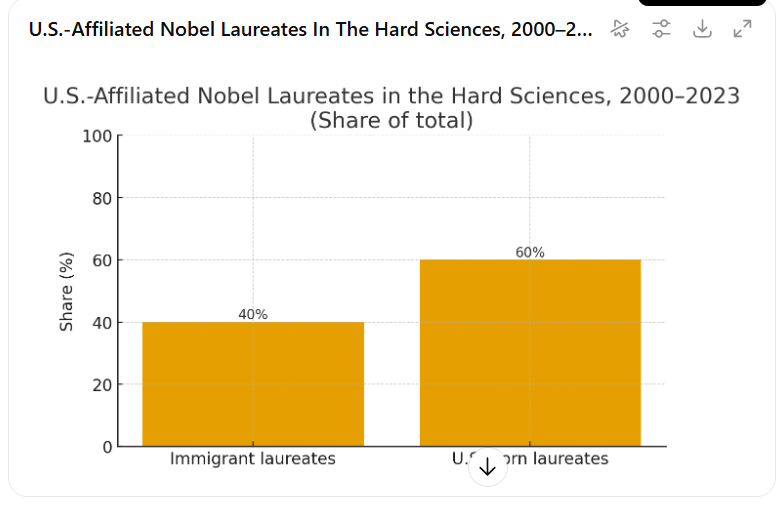
Unfortunately, even this explanation makes the lot of Africans even worse. Since Africans migrate to the US and other developed nations at a relatively high rate, one would expect a large share of migrant winners of these prizes to be from underdeveloped nations or Africa. But that is hardly the case, as you can see, a clear majority of the winners come from other developed nations.
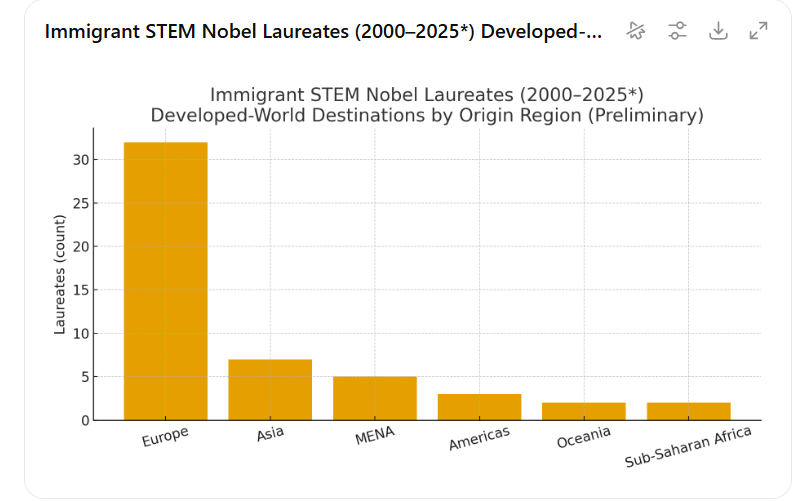
This is a sobering discovery, but it isn’t that bad, is it? In fact, maybe this chart proves me wrong. At least two immigrants from Sub-Saharan Africa have won a Nobel Prize. Those two are signs of what is to come, perhaps. I dug deeper into the matter and found that those two aren’t even the only Nobel Prize laureates in STEM who are immigrants. We actually have five, and here is a chart of their ethnicity.
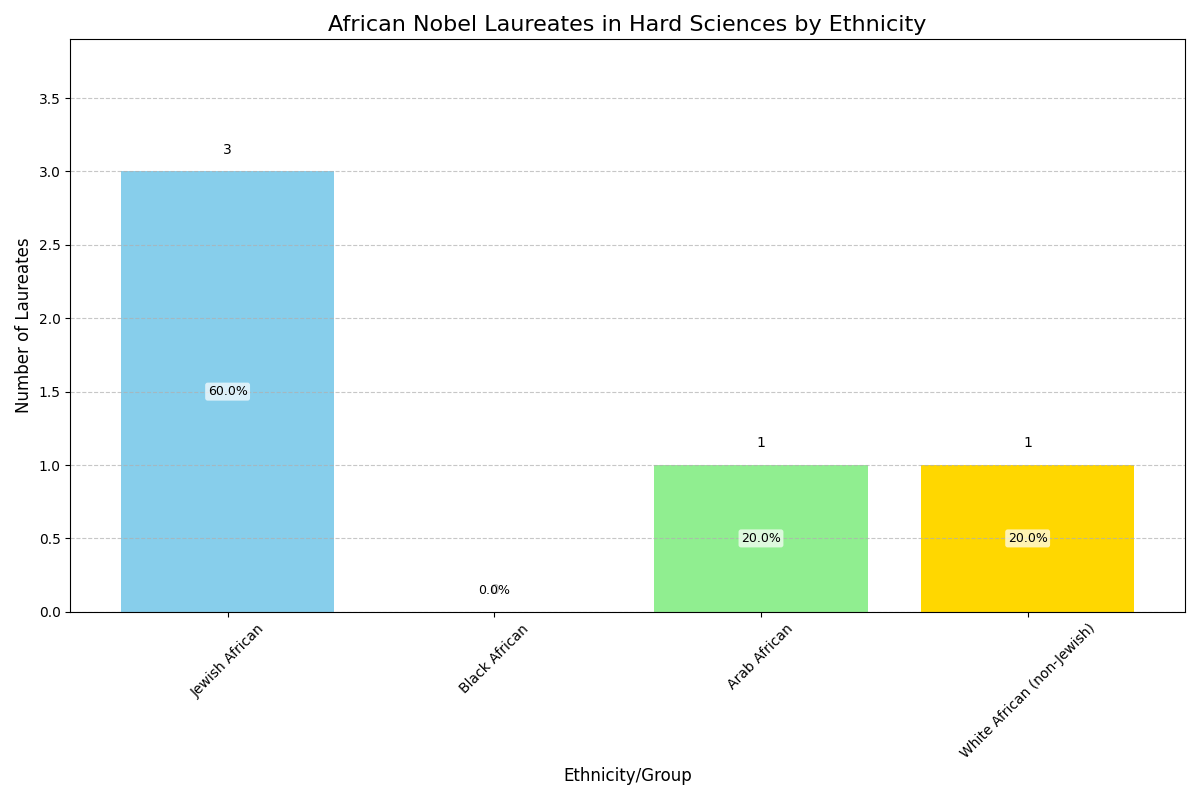
As you can see, four are white. One is Arab. I guess it isn’t that bad after all.
Similar Articles
200 rupee is #3000 not 3 million. Naira isn't that bad.